My EncoreMichigan.com review of ‘What Am I Doing Here?’ at the Yellow Barn

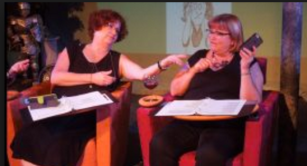
Screen Shot 2016-08-15 at 2.26.55 PMJudi Schram’s What Am I Doing Here? now being staged at Ann Arbor’s Yellow Barn in a joint production of Theatre Nova and Papa Weez, starts with four mature, dressed-in-black women entering the stage holding full wine glasses, plus a bottle for refills during the show.

And just like that, as each actress took a seat in an armchair, I felt cozy and comfortable in the company of ladies I already liked.

Drawn from material published on Schram’s blog, “What Am I Doing Here?” is a reader’s theater show – with the actresses reading from scripts – that takes various aspects of aging as its subject.

Broken up into chapters like “Memory,” “Doctors,” “Technology,” and more, the 75 minute show is built on Schram’s lighthearted poems, written in the style and spirit of Shel Silverstein’s work (as she openly acknowledges early on). Dieting, Spanx, not recognizing yourself in the mirror, absent-mindedness, hot flashes, mammograms, taking care of children and aging parents simultaneously, HGTV binge-watching, and prescriptions are among the topics tackled, and projected illustrations from Schram’s book “Lights Out in the Attic” (another nod to Silverstein) provide the show’s visual backdrop.

A problem inevitably arises, though, when the poems, which share a common structure and tone, start to feel redundant. Yes, they address different subjects, but as each builds toward a kind of punchline, you can’t help but yearn for more variety and bite.  READ THE REST HERE

My latest WEMU Art & Soul segment with Lisa Barry (and special guest A2SF Director Amy Nesbitt)

Screen Shot 2016-08-12 at 10.07.57 AM.png

Lisa and I talked about local upcoming performing arts events during August, and welcomed Ann Arbor Summer Festival director Amy Nesbitt into the WEMU studio to talk about A2SF’s final event of the year: a one-man circus, called L’homme Cirque, that’s coming to town August 24-28. Check out what Amy has to say about this amazing-looking, super-special event (which I’ll be reviewing for Pulp)! http://wemu.org/post/art-and-soul-performing-arts-one-man-circus

My We Love Dexter review of The Encore Theatre’s ‘My Fair Lady’

ShowPicsMFL-8.jpg

Daniel Gerroll and Jessica Grove in The Encore Theatre’s “My Fair Lady.” (Michele Anliker Photography)

Lerner and Loewe’s “My Fair Lady” is an American stage classic that’s an all-time favorite among musical theater fans; yet strangely, there seem to be precious few opportunities to see a live production.

All the more reason to get to the Encore Theatre – presuming you can still purchase tickets (2 performances were recently added to accommodate high demand) – as soon as you can.

For although, from a tech standpoint, Encore’s “loverly,” three hour production embodies the modesty of its blackbox theater – as director Tony Walton notes in the show’s program, Encore’s lack of wings or overhead space for a fly system limits the ways that production teams can flesh out a show’s scenic changes – the talent both on-stage and behind-the-scenes is anything but. READ THE REST HERE

My We Love Dexter preview for Encore Theatre’s ‘My Fair Lady’

ShowPicsMFL-14.jpg

Jessica Grove and Daniel Gerroll in The Encore Theatre’s “My Fair Lady.” (Michele Anliker Photography)

To say that Broadway veteran actress Jessica Grove – who’s married to Encore Theatre co-founder Dan Cooney, and who’s starring in Encore’s new production of the Lerner and Loewe classic, “My Fair Lady” – has been having a busy year would be a gross understatement.

“I was pregnant at callbacks (for ‘My Fair Lady’). I read with a few people, and I kept saying, ‘Just ignore this,’” Grove said, circling one hand over her midsection. (Her baby daughter, the couple’s second child, is now four months old.) “I didn’t know how it would work out, exactly. I honestly feel like my voice is just coming back through the rehearsal process, so that’s getting better. And throw a move on top of it – we’re moving (from New York) to Chicago. So right when I thought I’d get a head start on my lines, instead, I was packing. And we didn’t know we were moving until April, after Lolly was born. And then we had to find a place to live in Chicago.”

But through it all, Grove’s commitment to playing Eliza Doolittle, a dream role, never wavered, and two highly accomplished colleagues signed on to be part of the show, too. READ THE REST HERE

My Pulp review of Michigan Shakespeare Festival’s ‘Richard II’

RICHARD-II-02-MSF.jpg

Robert Kauzlaric stars in Michigan Shakespeare Festival’s “Richard II.”

Sometimes, when you see a Shakespeare play that’s rarely produced, you walk out thinking, “I’m pretty sure I know why.” But then, at other times, like an unexpected gift, you walk out of a production thinking, “Where have you been all my life?”

The latter describes my experience with Michigan Shakespeare Festival’s three-hour production of Richard II, now playing at Canton’s Village Theater.

The history play focuses on King Richard (Robert Kauzlaric), who’d been crowned at age 9, after his grandfather Edward III ruled England for 50 years, and his father, the natural heir, died.

Richard II takes place when Richard has reached adulthood, after wrangling with his father’s brothers for years to retain power. When one of Richard’s cousins, Henry Bolingbroke (Robert McLean), gets into a feud with a noble named Thomas Mowbray (Matt Daniels), who’s accused of being involved in the murder of one of Richard’s uncles, Richard banishes them both, thereby angering Bolingbroke’s father, John of Gaunt (Alan Ball). The rift sets events in motion, as Gaunt confronts Richard and later dies; Richard leaves England to reclaim power in Ireland; and Bolingbroke returns to England to not just claim his father’s title and land, but also Richard’s crown.

Many factors play into our response to a show, of course: design elements, the language, performers, pacing, the director’s choices, prominent themes, and even what personal experiences we’re bringing with us into the theater.

For me, this seldom-produced history play opened up near its end, when Richard has been usurped and imprisoned and says: “Alack the heavy day/ That I have worn so many winters out/ And know not now what name to call myself./ … But whate’er I be/ Nor I nor any man that but man is/ With nothing shall be pleased till he be eased/ with being nothing.” In this monologue, Shakespeare reflects not only on the experience of a person’s previously firm sense of identity in freefall, but also our shifting sense of our place in the world as we age – which is to say, the inevitable realization that each of us might not, after all, be super-special snowflakes. READ THE REST HERE

My Pulp review of Michigan Shakespeare Festival’s ‘The Killer Angels’

tobin_hissong.jpg

Tobin Hisson as General Lee in Michigan Shakespeare Festival’s “The Killer Angels.”

One thing you’ll inevitably think about while watching the Michigan stage premiere production of Karen Tarjan’s The Killer Angels – presented by Michigan Shakespeare Festival, and inspired by the 1975 Pulitzer Prize-winning Civil War novel of the same name by Michael Shaara – is how 19th century American warfare and military strategy look nothing like our contemporary conflicts; yet even so, brutality, death, and nightmarish confusion on the battlefield remain constants.

Focused on the three-day Battle of Gettysburg – cited by many as a key turning point for the victorious (uh, spoiler alert?) Union Army – Killer Angels introduces us to military leaders as well as infantrymen on both sides of the war.

How? By double- and triple-casting the production’s 12 actors. And while this casting instruction/suggestion is wholly practical, it nonetheless makes following the play’s already-complicated narrative that much harder. Indeed, if your knowledge of the Battle of Gettysburg is minimal – ahem – you’ll likely be struggling to keep the characters (and other details) straight.

But there’s also a larger storytelling paradox at work: a military battle must, by definition, involve lots of people; and yet, to establish an emotional connection to the story, the audience must have sustained, intimate access to a smaller group of characters. (This is how we follow Shakespeare’s history plays, which tend to focus less on a single battle and more on those vying for power.) Because so many leaders and soldiers played a key role – some for better, some for worse – in the Battle of Gettysburg, Killer Angels shifts focus often, providing only cursory glimpses of most characters. READ THE REST HERE

My EncoreMichigan.com review of ‘A Leaning Tower’ at the Yellow Barn

A-LEANING-TOWER-ELLIPSIS

Scott Screws in “A Leaning Tower”

Most of us aim, in the course of our lives, to build something that will outlast us. Many grasp at immortality by way of our children, whom we hope will carry our memory (not to mention our genetic code) into the future. But for the two characters in Joanna Hasting’s new play A Leaning Tower, presented by the recently-resurrected Ellipsis Theatre Company at Ann Arbor’s Yellow Barn, striving to build a structure that stretches into the heavens seems to be a goal that plays a prominent role in the pair being reincarnated again and again.

Fortescue (Hastings) is an artist who, in her current incarnation, dreams of building a grandiose, sky-scraping arts center that provides the world with a gathering place that celebrates art as a common language. And although she doesn’t remember it, her partner, an architect named Smythe (Scott Screws), tells her that in former lives they were twins joined at the forehead who designed the original Tower of Babel.

Building an enormous temple requires money, of course, so Fortescue and Smythe apply for, and receive, grants. But when the costs far outstrip the duo’s funds, they start robbing banks, hearkening back to their previous identities as Bonnie and Clyde, and as Butch Cassidy and the Sundance Kid. But can they sustain a crime spree long enough to finally see their goal through to its end, and thus stop this Sisyphean cycle?  READ THE REST HERE

My Culture Source story about Ann Arbor’s PowerArt! public art project

Screen Shot 2016-07-28 at 11.26.10 PM.png

L to R: “Legato,” Sophia Adeline Zhou; “People in the City,” Xiang Li; and “Pedestrian,” Tim Gralewski. (Photos by Allison Buck, courtesy of The Arts Alliance.

Ann Arbor has figured out a way to make the mundane beautiful while also supporting local artists.

How? By wrapping up drab traffic signal boxes in vinyl reproductions of locally produced artworks.

“They’re so pretty, but it also really makes the ones that aren’t decorated stick out more,” said Allison Buck, program director of The Arts Alliance, which proposed and oversees the project. “When you walk past a plain one, you think, ‘What about that one? And that one? Those should have art on them, too.’”

Phase two of Ann Arbor’s proposed three-phase public art initiative, called PowerArt!, ended in mid-July, covering 17 more signal boxes in artworks that were selected by a local jury composed of artists and community leaders (13), or by public online voting (4). The artists whose work was selected for PowerArt!’s second phase are: David Zinn, Tim Gralewski, Cathy Jacobs, Xiang Li, Thomas Rosenbaum, Bruce Worden, Sophia Adalaine Zhou, Parisa Ghaderi, K.A. Letts, Nawal Motawi, Mia Risberg, Bryan Oxender, Yiyi Zhang, Katharine Downie, Walter Griggs, Leslie Sobel, and Jill Stefanie Wagner. (Zinn, Rosenbaum, Zhou, and Letts had work selected for PowerArt!’s first phase as well.)

PowerArt!’s pilot phase began in May 2015, with eight boxes throughout downtown Ann Arbor receiving a makeover. Each PowerArt! artist—who must live, work, or attend school in Washtenaw County—received $1,450 per work. Organizers hope that in addition to highlighting local artists, the program will dissuade people from taping flyers to the boxes or tagging them with graffiti.  READ THE REST HERE

My Concentrate story on Girl Develop It – Ann Arbor

Screen Shot 2016-07-19 at 11.23.39 PM.pngAnn Arbor’s Cheryl Orosz was Detroit Country Day School’s first female student to earn a math/computer letter, and was once the only young woman in the school’s six-person computer competition club. A photo in her yearbook shows Orosz in front of a chalkboard, teaching her peers about hexadecimal math. For many, it would be obvious where her intellectual passion was destined to lead her.

But, like many women of her generation, Orosz found her professional aspirations (ie. her graduate studies at U-M) derailed by her personal life. Raising kids, no longer on the tech workforce track, she eventually found a part time position with the Washtenaw Intermediate School District (WISD).

“It was something I could do around school drop offs and school pick ups,” said Orosz.

It was at WISD that Orosz befriended a computer programmer who regularly attended Codemash, a conference that updates and educates developers on the latest tech trends and practices.

“While he was there,” Orosz says “he met Ronda (Bergman) and Julie (Cameron), who founded a chapter of Girl Develop It in Ann Arbor, and he said, ‘Cheryl, you need to talk to these ladies.'” READ THE REST HERE

My Pulp review of Penny Seats Theatre’s ‘Xanadu’

Screen Shot 2016-07-19 at 11.11.19 PM.png

Pennt Seats Theatre is now presenting “Xanadu” at the West Park band shell.

Sometimes, you actively avoid re-visiting the most beloved TV shows and movies of your youth, because you know in your gut that the adult, more critical version of yourself will see nothing but flaws.

Yet when a witty playwright like Douglas Carter Beane (“The Little Dog Laughed,” “Lysistrata Jones,” “As Bees in Honey Drown”) adapts one of your favorite childhood movies – Xanadu, now being staged by Penny Seats Theatre – you get the best of both worlds. Yes, Beane affectionately mocks the campy film musical’s laughable absurdity, but he also unabashedly grants us permission to re-visit it, as well as its still-appealing ‘80s score (by Jeff Lynne and John Farrar).

For those of you who, for some reason, didn’t hold a cassette recorder up to the TV as Xanadu played on your family’s jerry-rigged cable system – ahem – here’s the story: frustrated Venice Beach artist Sonny Malone (Matt Pecek) is about to give up when Kira (Paige Martin) rolls into his life on a pair of skates. She’s a muse, one of 9 Greek sister goddesses who inspire artists, so she guides Sonny toward his dream: a roller disco that’s also an arts showplace. Naturally.

But when Sonny becomes business partners with a rich, older man (Roy Sexton) from Kira’s past, and Kira’s jealous sisters (Allison Simmons and Kasey Donnelly) decide to intervene to bring the upstart down, Sonny’s roller disco dream hangs in the balance.

Penny Seats’s outdoor production (in West Park) struggled mightily with sound issues on opening night. The actors’ mics were hit-and-miss, which meant that some lines (and jokes) got lost; ensemble numbers, particularly near the beginning, never quite gelled, vocally; and the show’s band – situated on the West Park band shell stage, a good distance behind where the action unfolds (which may have been one source of the problem) – often sounded pretty rough and out of sync, shifting tempos and struggling to align with the performers. READ THE REST HERE